
 VS
One Case, Two Detectives
You have your suspects, your rival has theirs, and the map is the same. There is no clock: the pressure comes from the other player.
You do not read all the statements at once, as in a regular case: they come on cards, and you start with a few in your hand.
Drawing Means Showing
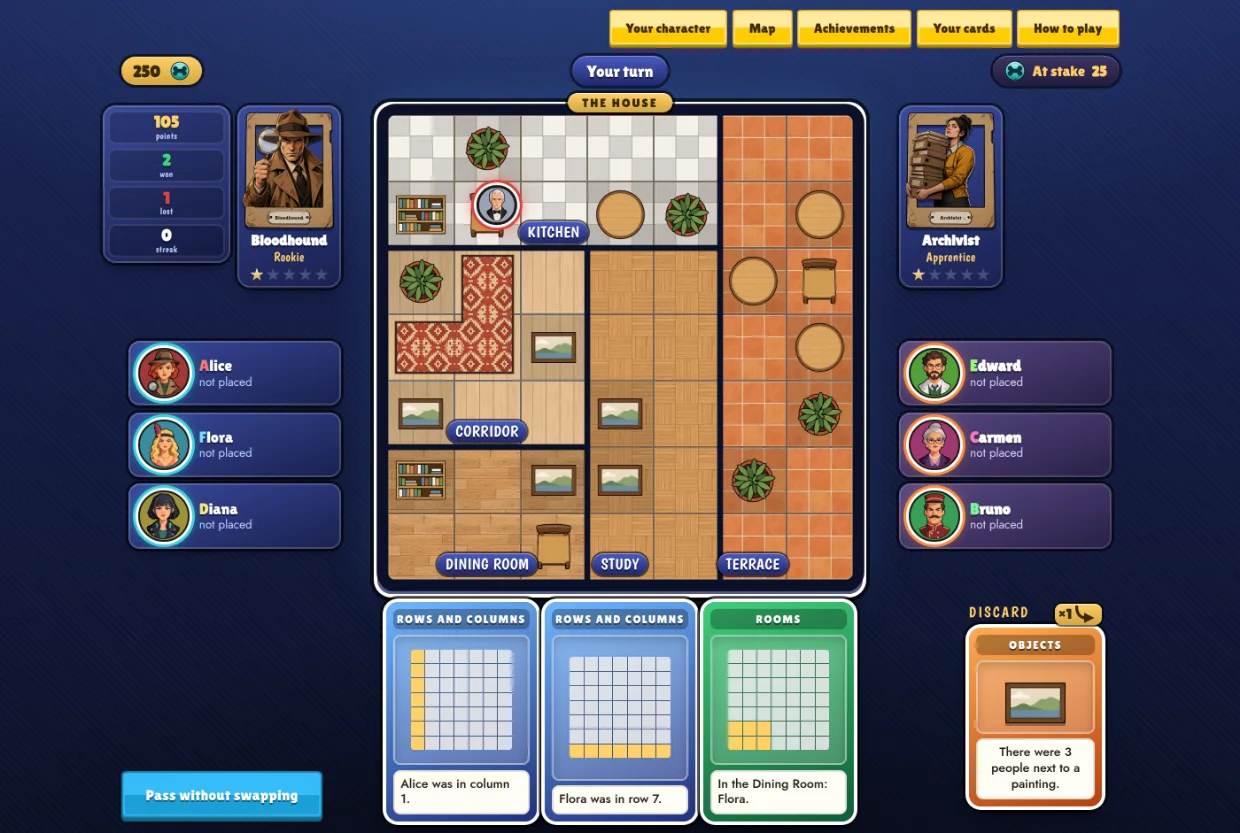
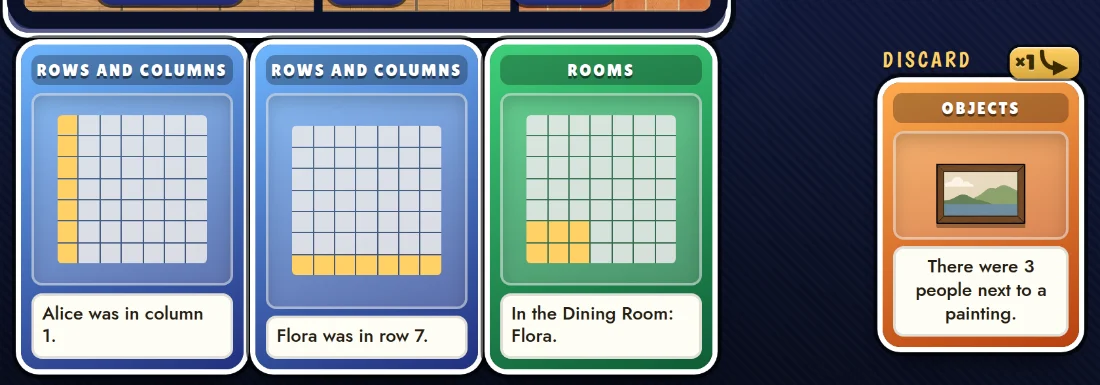
The cards say where someone was: in an area, next to an object or somewhere in a whole row. The smaller the place, the better the card.
And that is the duel: every turn you decide whether to draw a new card — handing your rival the one you drop — or pass without drawing and hold on to the little that is already yours.
The Map Is Your Notebook
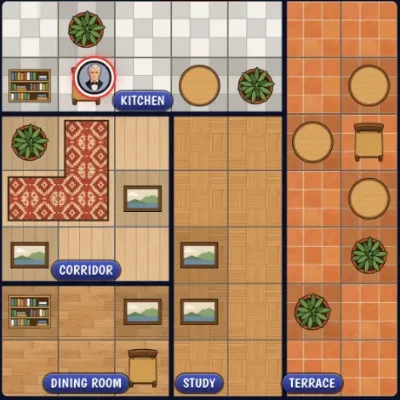
Tap a square for an X (“nobody can be here”) and again for an O (“someone is here, but I don’t know who”). Every person you place crosses out their whole row and their whole column.
The full method, with a case solved from start to finish, is in how to solve a case.


 A
 KitchenLiving RoomBedroomDining Room
Pinning Is Betting
Marking is free. Pinning means saying “this one goes here” and betting that it is true.
That gives you the only tactic you need to understand: pin only what is proven, not what is likely. The player who loses is almost always the one who got nervous.
One Win, One Level
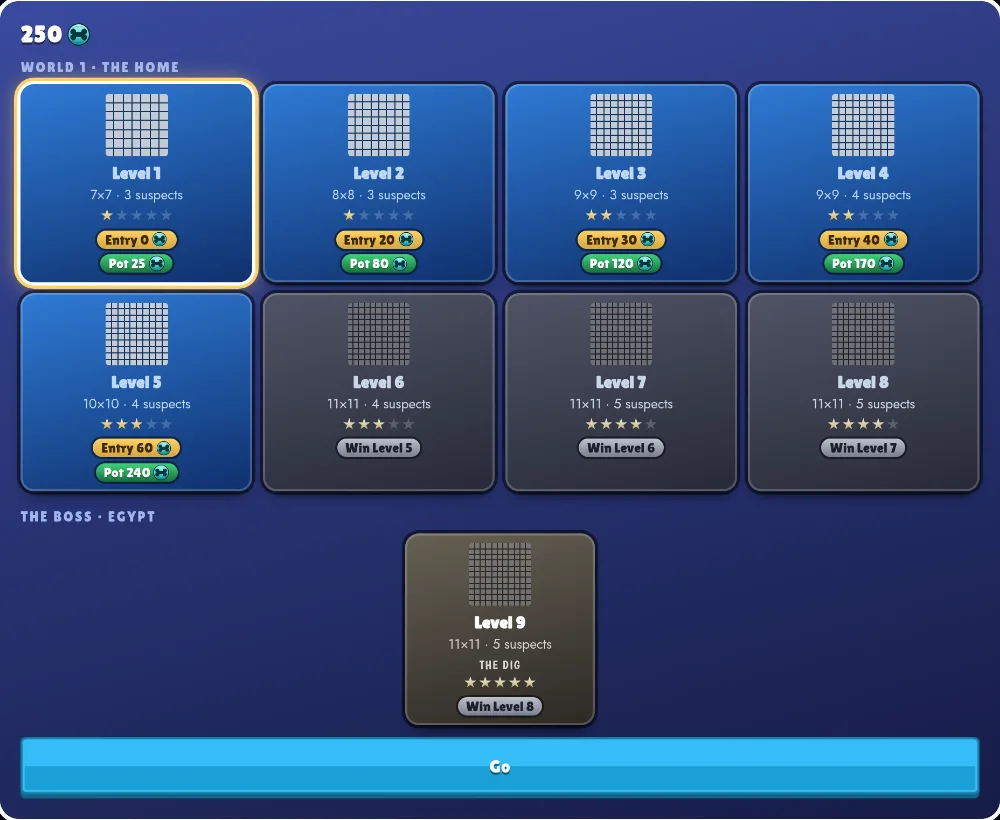
Each level brings a bigger map with more people on it, with its own entry fee and its own pot. The settings open the same way, one at a time, up to the last one, which is not a house.
Winning earns you chips for the entry fees higher up and points for your rank, which unlocks characters. There is nothing to pay for with real money.
Who You Play Against, and Where
Your rival is the computer, not another person online: open the page and there is a game. At the lower levels it gets distracted and hands you good cards; at the top it does not miss a thing. You can see its stars before you start.
You play in the browser, in the duel: free, with no account and nothing to install, and on a phone it all fits on one screen.
And When You Want a Case With No Rush: The Book
The duel is the fast one. The slow one — a big case, with its illustrated setting and the solution explained step by step — is Sudoku Detective. There are also printable cases and the full rules.
And if you came here from Murdoku, that page lists other games like it.
Frequently Asked Questions
Do you play against another person?
No: your rival is the computer, and it plays better the higher the level. You do not have to wait for anyone to log on: open the page and there is a game.
Do I have to pay or sign up?
No. You play in the browser, for free, with no account, no email address and no ads. The chips in the game are won by playing and cannot be bought with money.
What happens if I pin a suspect on the wrong square?
Your rival plays twice in a row. That is why you only pin what is proven: marking squares with X and O is free, pinning is a bet.
How do the levels open?
By winning the one before: one win, one level. The settings work the same way, one at a time. You start at the lowest level, which has no entry fee, so there is always a game to play.
What are the chips for?
They pay the entry fee for the higher levels, which have bigger pots. Points are something else: they raise your detective rank, and your rank unlocks characters and card designs.
Can I play on my phone?
Yes. The duel page fills the screen and there is no scrolling: the map, your hand of cards and your rival all fit at once.
Is it the same as Murdoku?
It is the same genre: a sudoku where the numbers are suspects and the clues are signed statements. The duel adds the rival, the cards and the face-up discard pile, and you play it in the browser instead of on paper.
What languages is it in?
All seven languages of the site: Spanish, English, French, Italian, German, Portuguese and Dutch. The cards and the statements are written in each language, not machine-translated.
Pass it on to a friend